Eleven islands in five island groups, and who each one suits
Which Greek Island Should You Visit?
No Greek island is best for everyone. Pick by the trip you want, from Santorini's caldera and Crete's Minoan palaces to a day on Hydra, where cars are not allowed, and in October 2026 by what is open: Samaria Gorge on Crete is closed until further notice, and landing at Navagio on Zakynthos is banned until 31 October.
Eleven Islands in Five Island Groups
Choose the Island, Then the Day Out
Open an island to see who it suits, how you get there from Athens and from its neighbors, what 2025 and 2026 changed, and which tours cover it, with where each one leaves from.
Santorini
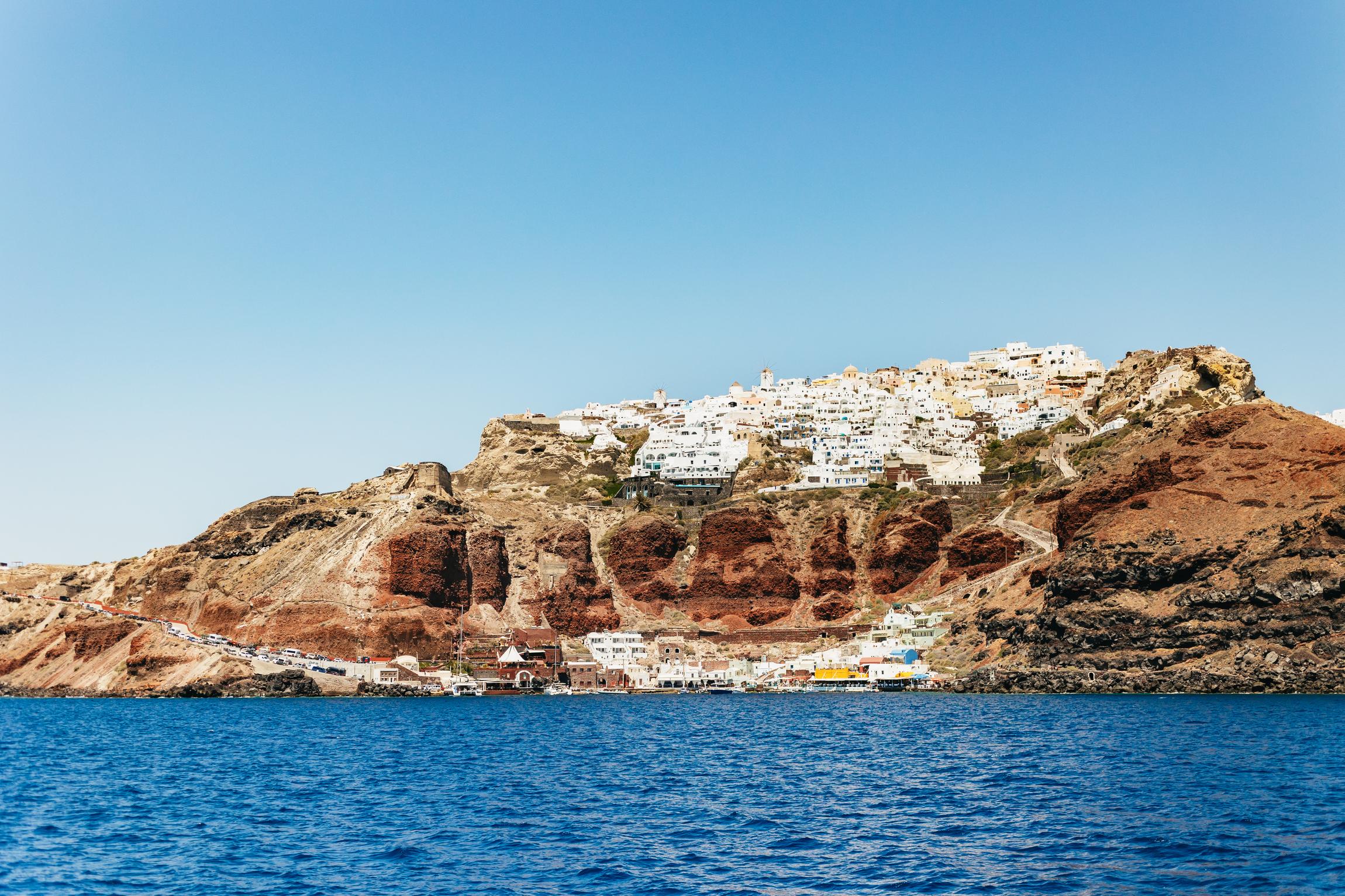
All five guides we read pair it with couples, and Visit Greece calls its sunset over the caldera the most renowned in Greece. Since 2026 its cap of 8,000 cruise passengers a day counts every ship at full capacity, and the access rules set after the 2025 earthquakes run to 31 March 2027.
Sunset on the caldera →
GREECE'S LARGEST ISLANDCrete
Both Condé Nast editions send families here, and Heraklion took 4.05 million international arrivals in 2025, the most of any island airport. As of early October 2026, Samaria Gorge is closed “until further notice” after storms across Crete.
Knossos to Spinalonga →
PICKED FOR NIGHTLIFEMykonos
All five guides we read pick it for nightlife, and in 2025 it landed 1,222,748 cruise passengers, slightly more than Santorini. Its airport runway closes every Thursday from 19 November 2026 to 18 March 2027.
Little Venice and Delos →
FOR UNDERWATER EXPLORINGMilos
Lonely Planet's island for underwater exploration, with more than 70 beaches by its count and 80 by Visit Greece's. The port fund caps cruise passengers at 1,500 a day at Adamas.
Sarakiniko and Kleftiko →
CENTER OF THE CYCLADESParos
Visit Greece puts it at the center of the Cyclades, with wide sandy beaches, and Naxos is 25 to 30 minutes away by fast ferry. Condé Nast Traveller's UK edition picks it for an authentic experience.
Naoussa and Antiparos →
LARGEST OF THE CYCLADESNaxos
One of Lonely Planet's family picks, “where kids can safely swim in shallow waters”, and in Visit Greece's words the largest and most fertile island of the Cyclades. It landed 10,311 cruise passengers in 2025; Mykonos landed 1.2 million.
Villages and a cooking class →
MEDIEVAL CITY · UNESCO 1988Rhodes
Lonely Planet's pick for medieval history, with a walled Old Town on UNESCO's list since 1988 and the acropolis of Lindos. The ferry from Piraeus takes at least 15 h 40, so for a short trip you fly.
Lindos and a day on Symi →
OLD TOWN · UNESCO 2007Corfu
Lonely Planet's island for boating, with an Old Town of Venetian-designed forts. It is wetter than the Aegean in autumn: 140.4 mm of rain in an average October, against 38.6 mm on Naxos.
Old Town and Paxos →
HIKING AND NATUREKefalonia
Condé Nast Traveller's UK edition picks it for hiking and nature, Lonely Planet for “rugged romance”. Ithaca is 31 minutes away by ferry from Sami, by Visit Greece's timing.
Melissani and Ithaca →
NAVAGIO UPDATE · OCT 2026Zakynthos
Navagio (Shipwreck Beach) is closed to landing and swimming until 31 October 2026; you see it from the clifftop viewpoint or from a boat in a buoyed zone. Visit Greece calls the island a haven for loggerhead turtles.
What you can see now →
A DAY FROM ATHENSHydra
The Rick Steves Greece page rates it ▲▲▲, above Santorini and Mykonos, as an island getaway “convenient to Athens”. Cars and motorbikes are not allowed (Visit Greece), and the fastest direct boat from Piraeus takes 1 h 15.
Getting there from Athens →
THE SMALLER ISLANDSThe Quieter Islands
Lonely Planet and Condé Nast Traveller's UK edition both pick Kythnos for a quiet stay, and Visit Greece calls Amorgos “a tranquil romantic refuge”. Folegandros landed 434 cruise passengers in 2025; Santorini, 1.2 million.
The smaller islands, one by one →
EIGHT ISLAND GROUPSThe Greek Islands Map
Where each island sits in Visit Greece's eight groups, with the ports and airports that link them. The Ionian islands do not sail from Piraeus, Rafina or Lavrio.
Open the map →
How to Choose
Eleven Islands, Eleven Different Trips
Who each island suits in the words of the guides that say so, how you get there, and what 2025 and 2026 changed.
The best Greek islands to visit depend on the trip you have in mind, and no single island wins for everyone. Read five of the guides that recommend islands side by side (Visit Greece, the Greek National Tourism Organisation’s site; Lonely Planet; Condé Nast Traveller in the UK; Condé Nast Traveler in the US; and Rick Steves) and they agree on two things only: Santorini for couples and Mykonos for nightlife. Beyond those two, they split.
This page compares eleven islands from five of the eight groups Visit Greece sorts them into. Santorini, Mykonos, Milos, Paros and Naxos are in the Cyclades. Crete is a group of its own, Rhodes is in the Dodecanese, and Corfu, Kefalonia and Zakynthos are in the Ionian Sea. Hydra is one of the Argo-Saronic islands, close to Athens. Each island has its own page with a featured day out, the other tours listed for it and where each one leaves from.
Pick the trip first. Then check how you would get there, and what is open in the month you go.
Who should pick which
Each pick below names the guide behind it.
- Couples: Santorini, in all five. The Rick Steves page calls it a “romantic island”, and Condé Nast Traveler (US) makes it the honeymooners’ island. Visit Greece’s own list for couples adds Milos and Amorgos, and Lonely Planet gives Kefalonia “rugged romance”. The honeymoon guide weighs them up.
- Nightlife: Mykonos, again in all five. The Rick Steves page mentions its “pulsating nightlife”, and Condé Nast Traveler (US) its “decadent parties and five-star hotels”.
- Families: Crete, in both Condé Nast editions. Lonely Planet suggests Naxos, “where kids can safely swim in shallow waters”, and names Syros “especially for families”; Condé Nast Traveler (US) adds Kefalonia for laid-back family vacations. The families guide goes through them.
- A first trip: Lonely Planet says most first-timers choose the Cyclades and home in on Santorini and Mykonos. Condé Nast Traveler (US) says that if you are unsure, “Crete is your best bet”.
- History: Lonely Planet picks Crete for archaeology and Rhodes for medieval history. Crete’s six “Minoan Palatial Centres”, Knossos among them, joined UNESCO’s World Heritage List together in July 2025.
- The sea: Lonely Planet calls Milos the island for underwater exploration and counts “more than 70 beaches” there; Visit Greece counts 80. Condé Nast Traveller (UK) picks Crete for beaches, and Lonely Planet picks Corfu for boating. The beaches guide compares the coasts.
- A short trip from Athens: Hydra. The Rick Steves page rates it above Santorini and Mykonos and calls it “convenient to Athens”; Condé Nast Traveler (US) suggests it for a long weekend. Cars and motorbikes are not allowed on the island (Visit Greece).
- Hiking and nature: Kefalonia, in Condé Nast Traveller (UK).
- A tight budget: of the five, only Lonely Planet takes this on. It calls Santorini and Mykonos “A-lister” islands, says bargains are hard to find from July to September, and calls Crete “one of the most affordable destinations in the Mediterranean”. The cheapest islands adds what drives the cost.
- Paros or Naxos: Condé Nast Traveller (UK) chooses Paros for an authentic experience. Lonely Planet sends families to Naxos and names both as quieter alternatives to Mykonos. Naxos or Paros sets them side by side.
- Zakynthos: none of the five matches it to a kind of traveler. Visit Greece calls it a haven for loggerhead turtles, and its best-known beach, Navagio, is closed to landing until 31 October 2026.
Two more matchups have pages of their own: Santorini or Mykonos and Crete or Santorini.
Eleven islands side by side
Flight times are Visit Greece’s, from Athens. Ferry times are the operators’ own where they publish one. The crowd figures are the closest official proxies: passengers arriving on international flights in 2025, from the civil aviation authority (HCAA), and cruise passengers landed in 2025, from the Hellenic Ports Association (ELIME).
| Island | Group | Getting there | Who it suits, per the guides | Crowds and current notes | The featured day out |
|---|---|---|---|---|---|
| Santorini (Thira, or Thera) | Cyclades | Fly from Athens in 50 min; fast ferry from Rafina 5 h 30 (Golden Star), or about 8 h by conventional ferry from Piraeus (Blue Star) | Couples (all five guides) | 1,203,052 cruise passengers in 2025, under a cap of 8,000 a day; the airport handled 16% fewer passengers in 2025 than in 2024 | Catamaran cruise with a barbecue dinner from Ammoudi port below Oia, hotel pickup included |
| Crete | Crete | International flights to Heraklion and Chania; overnight ferry from Piraeus to Heraklion, 9 h 30 (Minoan Lines) | Families (both Condé Nast editions); archaeology and budget (Lonely Planet) | 4.05 million international arrivals at Heraklion, the most of any island airport; Samaria Gorge closed until further notice since 1 Oct 2026 | Coach day trip, with pickups along the coast from Ammoudara to Sisi, to Agios Nikolaos, Elounda and Spinalonga; the €20 Spinalonga ticket is extra |
| Mykonos | Cyclades | Fly from Athens in 45 min; fast ferry from Rafina 2 h 30 (Golden Star) or from Piraeus 2 h 40 (SeaJets) | Nightlife (all five guides) | 1,222,748 cruise passengers in 2025, a little more than Santorini; runway closed on Thursdays from 19 Nov 2026 to 18 Mar 2027 | Cruise from the Old Port to Delos and Rhenia with lunch; the Delos site ticket is extra |
| Milos | Cyclades | Fly from Athens in 40 min (no international flights); fast ferry from Piraeus 2 h 30 (SeaJets) | Underwater exploration (Lonely Planet); couples (Visit Greece) | Cruise passengers capped at 1,500 a day at Adamas; boats must keep 25 m off Kleftiko’s cliffs | Full-day sail from Adamas around the island and to Polyaigos, lunch on board |
| Paros | Cyclades | Fly from Athens in 45 min (almost no international flights); ferry from Piraeus 4 h 10 to 4 h 30 (Blue Star) or 3 h 45 (SeaJets) | An authentic experience (Condé Nast Traveller UK); a quieter Mykonos (Lonely Planet) | 13,290 cruise passengers in 2025; Naxos is 25 to 30 min away by fast ferry | Full-day boat from Pounta or Antiparos along Antiparos’s south coast to Despotiko, lunch on board |
| Naxos | Cyclades | Fly from Athens in 45 min (no international flights); ferry from Piraeus 5 h 20 to 5 h 50 (Blue Star) or 4 h 20 (SeaJets) | Families with kids (Lonely Planet) | 10,311 cruise passengers in 2025; the strongest July wind in the weather service’s island normals, 13.3 knots from the north | Half-day cooking class at a family tavern in Potamia, 10 km from Naxos Town; no transfer included |
| Rhodes (Rodos) | Dodecanese | International flights; ferry from Piraeus from 15 h 40 (Blue Star) | Medieval history (Lonely Planet) | 3.06 million international arrivals in 2025; the Lindos acropolis and the Grand Master’s Palace €20 each since April 2025 | High-speed boat from Mandraki Harbour to Symi, with three hours there and a swim stop in Saint George’s Bay |
| Corfu (Kerkyra) | Ionian | International flights; fly from Athens in about 1 h 15; ferries from Igoumenitsa on the mainland, none from Piraeus | Boating (Lonely Planet) | 2.08 million international arrivals and 894,179 cruise passengers in 2025; 140.4 mm of rain in an average October | Day cruise from Corfu port to Paxos, Antipaxos and the Blue Caves, with pickups on some options |
| Kefalonia (Cephalonia) | Ionian | International flights; ferry from Kyllini to Poros in about 1 h 30 | Hiking and nature (Condé Nast Traveller UK); “rugged romance” (Lonely Planet); family vacations (Condé Nast Traveler US) | A landslide at Myrtos beach on 9 Jul 2026; signs ban sitting near the foot of the cliff | Traditional boat from Argostoli harbor with lunch, stopping at White Rocks, Vardiani and Xi |
| Zakynthos (Zante) | Ionian | International flights; fly from Athens in about 1 h; ferry from Kyllini in about 1 h 15, all year | None of the five names it for a type of traveler | 1.08 million international arrivals in 2025; Navagio closed to landing and swimming until 31 Oct 2026 | Land-and-sea day with hotel pickup: Navagio from the clifftop and from a boat, and the Blue Caves; the boat ticket (€25 per adult, or €50 by speedboat, paid in cash) is extra |
| Hydra | Argo-Saronic | No airport; high-speed boat from Piraeus, 1 h 15 at the fastest direct (Alpha Lines) | A short trip from Athens (Rick Steves; Condé Nast Traveler US) | No cars or motorbikes (Visit Greece); 14,186 cruise passengers in 2025 | Coach from central Athens via the Corinth Canal to Metochi, then a sea taxi across; the €20 sea-taxi ticket is extra |
On a phone, swipe the table sideways.
Crete and Rhodes are a night or most of a day from Piraeus by ferry, so for a short trip you fly. Milos, Naxos and Paros get almost no international flights; you reach them through Athens or by sea.
How many islands there are
Visit Greece puts the total at “6,000 islands and islets”, “of which only 227 islands are inhabited”, without a year or a definition. The census-based count is lower: 114 inhabited islands at the 2011 census, plus 440 islets recorded with no population, according to the University of the Aegean’s island atlas. Lonely Planet says 2,000-plus, about 250 of them inhabited. Totals run from 1,200 to 6,000 depending on how small an islet you count, and no count from the 2021 census could be found. How many Greek islands are there sets the counts and the island groups side by side.
The quieter islands
For fewer people, the guides point beyond these eleven. Lonely Planet and Condé Nast Traveller (UK) both pick Kythnos, and the UK edition adds Kastellorizo. Lonely Planet sends couples “seeking serenity and umbrella-free beaches” to the Small Cyclades and suggests Folegandros instead of Santorini, and Visit Greece calls Amorgos “a tranquil romantic refuge”. The numbers bear the quiet out: Folegandros landed 434 cruise passengers in 2025, Santorini 1,203,052. What these islands trade is access. Folegandros and Amorgos have no airport, and Visit Greece routes you by ferry from Milos (55 minutes to 2 h 50) or from Naxos (1 h 15 to 6 h). Water is short on some small islands too: Patmos and Leros were declared water-scarcity emergencies in November 2025, later extended, and Astypalaia in May 2026. The least touristy islands takes them one by one, with how to reach each.
One island, two or three
Lonely Planet’s advice for a week is one island group and two or three islands. The Cyclades make that easy. By SeaJets’ own times, Paros to Naxos takes 25 to 30 minutes, Mykonos to Paros 35 to 50, Naxos to Santorini 1 h 10 to 1 h 30, and Santorini to Milos 1 h 55. Crete links to Santorini by Blue Star’s conventional ferry and SeaJets’ high-speed boats, Rhodes to Symi by boats of about 45 minutes to 1 h 30, and Kefalonia to Ithaca by a 31-minute crossing from Sami, in Visit Greece’s timing.
The Ionian islands are a separate trip. No ferries run to them from Piraeus, Rafina or Lavrio; they sail from Kyllini, Patras, Astakos or Igoumenitsa on the mainland, so pairing Corfu or Zakynthos with the Cyclades means a mainland crossing or a flight.
Two more things to plan around. The ferry timetable year runs from 1 November to 31 October, and some links run only in high summer: Fast Ferries calls at Paros from Rafina only between 13 June and 13 September 2026. And the meltemi, the north wind of the Aegean summer, blows from June, when it was strong on 24 of the 30 days in 2025, and it can stop sailings: on 14 August 2026 ships were held in Rafina and Lavrio until 16:00. SeaJets itself advises a spare day before a flight in July and August. Island hopping has the routes and realistic combinations, and the islands map shows where each island sits and which ports link them.
What changed in 2025 and 2026
Since 21 July 2025, cruise passengers pay a fee at every Greek port where they land, whatever their age: €20 at Santorini and Mykonos from June to September, €12 in April, May and October and €4 from November to March, and €5, €3 or €1 at every other port; ferry and air passengers do not pay it. The climate resilience fee that hotels and rentals add per room per night, not per person, has been €2, €5, €10 or €15 by star rating from April to October since 2025, €8 for short-term rentals, and less from November to March. On Santorini, the earthquake swarm that began on 27 January 2025 was a magmatic dike intrusion according to peer-reviewed studies published that year, with counts from about 25,000 to more than 50,000 quakes depending on the method; a state of emergency declared in February 2025 was extended into July 2025, and the cable car and Old Port reopened on 15 May 2025. The access decision now in force runs to 31 March 2027: the Old Port, the cable car, Armeni, Ammoudi village and the path from Ammoudi up to Oia are open, while the footpath from Ammoudi to Cape Agios Nikolaos, one zone of the Old Port and the Ammoudi road, closed to most vehicles since a May 2024 landslide measure, stay shut. Red Beach has been closed to visitors since 2013, and boats view it from offshore. As of early October 2026, Samaria Gorge on Crete has been closed at both entrances “until further notice” since 1 October after storms and floods across the island, and Knossos shut from 14:00 on 3 October because of the weather. Navagio on Zakynthos is closed to landing and swimming until 31 October 2026; boats may pass only through a buoyed viewing zone, for 20 minutes at most and 15 boats at a time. Check the island page and the tour’s calendar in the week you book.
Guides for the next decision
Each guide takes one of these questions further: Santorini or Mykonos, Naxos or Paros, Crete or Santorini, a honeymoon, families, beaches, the cheapest islands, island hopping, the quieter islands, the islands map and how many islands there are.
Choosing a Greek Island: What People Ask First
The questions people search before they pick an island, each answered in its first sentence, with the source named after it.
Start with the trip you want, then the island group. The guides agree only on Santorini for couples and Mykonos for nightlife; for families they name Crete, Naxos or Kefalonia, for history Crete or Rhodes. Then check access: Milos, Naxos and Paros get almost no international flights, and no ferries run to the Ionian islands from Piraeus. Lonely Planet suggests one group and two or three islands a week. The islands map shows the groups.
The guides do not agree on a top three, but three islands keep coming up. All five we read pair Santorini with couples and Mykonos with nightlife, and Condé Nast Traveler's US edition says that if you are unsure, “Crete is your best bet”. Lonely Planet adds that most first-timers choose the Cyclades and home in on Santorini and Mykonos. Compare Santorini and Mykonos or Crete and Santorini.
Rather than an island to avoid, look at the crowds and at what is open. Mykonos and Santorini landed 1.22 and 1.20 million cruise passengers in 2025, and Lonely Planet suggests quieter swaps: Folegandros for Santorini, Paros or Naxos for Mykonos. As of early October 2026, Crete's Samaria Gorge is closed until further notice and Zakynthos's Navagio beach is closed to landing until 31 October. The quieter islands.
Lonely Planet notes that more travelers now pick May, September or October, because of summer heatwaves. The weather service's warmest stretch is late July to early August, with mean highs of 29 to 35°C, and hotels were 86% full in August 2025 against 55% in May and 49% in October (ITEP). The meltemi wind blows from June. In winter much closes: 62% of hotels are seasonal, open 5.8 months on average.
No single month: on the islands most rain falls between mid-October and March, and summer is nearly dry. By the weather service's normals, Naxos gets 67.9 mm in an average January and under 3 mm a month from June to August. The Ionian is wetter than the Aegean: Corfu averages 140.4 mm in October, against 38.6 mm on Naxos, and Rhodes averages 151.8 mm in January.
Crete, by the best official proxies. The Bank of Greece counted 6.35 million visits to Crete in 2025, and Heraklion airport took 4.05 million passengers off international flights, ahead of Rhodes (3.06 million) and Corfu (2.08 million). Airport totals overstate visitors, since they add departures and residents. By sea the order changes: Mykonos landed 1,222,748 cruise passengers in 2025 and Santorini 1,203,052.
The guides name several small islands rather than one. Lonely Planet and Condé Nast Traveller's UK edition both pick Kythnos, the UK edition adds Kastellorizo, Lonely Planet suggests the Small Cyclades, and Visit Greece calls Amorgos “a tranquil romantic refuge”. Cruise numbers show the gap: Folegandros landed 434 cruise passengers in 2025, Santorini 1,203,052. The quieter islands, one by one.
Crete, says Lonely Planet, the only one of the five guides we read that covers budget: “one of the most affordable destinations in the Mediterranean”. It calls Santorini and Mykonos “A-lister” islands and says bargains are hard to find from July to September. Every island adds the climate resilience fee per room per night: €2 to €15 by star rating from April to October, €8 for short-term rentals. The cheapest islands.
Crete is the pick of both Condé Nast editions; Lonely Planet suggests Naxos, “where kids can safely swim in shallow waters”. Lonely Planet also names Syros “especially for families”, and Condé Nast Traveler's US edition adds Kefalonia for laid-back family vacations. Before you book a day out, check the tour's own age limits on its page. The families guide compares the islands.
Santorini is the island all five guides we read pair with couples. Visit Greece calls its caldera sunset, watched from Oia, Fira and Imerovigli, the most renowned in Greece. Its list for couples adds Milos, with 80 beaches, and Amorgos; Lonely Planet gives Kefalonia “rugged romance” and sends couples seeking serenity to the Small Cyclades. The honeymoon guide compares them.
Mykonos for nightlife and Santorini for couples: those are the two points all five guides agree on. Santorini's villages sit on the rim of a volcanic caldera; Mykonos has Little Venice, its windmills and the boats to Delos. Both charge cruise passengers Greece's highest port fee, €20 a head from June to September, and in 2025 Mykonos landed slightly more of them, 1,222,748 to 1,203,052. Santorini or Mykonos, compared.
They suit different trips. Crete, Greece's largest island, is the Condé Nast pick for families and Lonely Planet's for archaeology, and Knossos joined UNESCO's list in July 2025. Corfu is Lonely Planet's island for boating, with an Old Town listed since 2007. Corfu is wetter in autumn, 140.4 mm of rain in an average October against 59.4 mm at Heraklion, and a little hotter in July: mean highs of 31.2°C against 28.9°C.
Stay within one island group and let the ferries do the work. In the Cyclades, SeaJets times Paros to Naxos at 25 to 30 minutes and Naxos to Santorini at 1 h 10 to 1 h 30, while no ferries run to the Ionian islands from Piraeus, Rafina or Lavrio. Lonely Planet suggests two or three islands a week. The meltemi can stop summer sailings, and SeaJets advises a spare day before a flight in July and August. Island hopping.
It depends on who counts and how small an islet they include. Visit Greece says 6,000 islands and islets, “of which only 227 islands are inhabited”, giving no year or definition. The census-based count is 114 inhabited islands at the 2011 census, plus 440 islets with no population (University of the Aegean). Lonely Planet says 2,000-plus, about 250 inhabited. How many islands, and which.
Still have questions? Email us at info@bestgreekislandstovisit.com
Every Tour, Island by Island
Every tour listed here has its own page with the price, rating and review count, and the harbor, hotel pickup or Athens meeting point it starts from.